
Student Resources for Summary + Research Constructed Response

You may be rolling your eyes, shaking your heads, and silently (or boldly!) thinking: "Wait--there's more than one kind of constructed response now...and our students need to know how to do both? What the what? Are they kidding?"
And if you're in the Are you kidding me? camp, you probably aren't alone...and to be honest, I even had that flash of thinking for a moment when I saw that there were two different rubrics from the Indiana Department of Education for constructed response now:
These links are shared via newsletters, online, social media, and through the free IDOE resource, IN Learning Lab. The Learning Lab is a free, accessible resource for all educators and provides most (if not all) of the support resources provided from the state of Indiana. They're continually updating test blue prints, student writing samples, and, in this case, rubrics.
But then I realized that I actually like the categorization of the 2 rubrics--because the truth is--students are asked to use the organizational structures of both summary and research in their constructed responses. I'm just not so sure we were teaching them to do so.
Summary constructed responses ask students to pick out the main ideas and supporting details in either a story or nonfiction text. For students in Grades 5-8, they are then asked to determine a theme for the story, too. And this actually makes sense because it's an appropriate assessment for the RC.2 reading standards.
But listen--a typical research constructed response acronym does not work for this. Students need to be able to summarize the Who, What, Where, When, Why + How of an event--or name the Somebody Wanted But So Then of a story--and this writing structure is not the writing structure of RACE (or as I now prefer, PACER!)
I'm sharing some downloadable templates to use with students to help them prewrite, draft, and self-evaluate their writing. I'm also sharing some student-friendly rubrics you can print for both summary and research writing.
Here we go:

You'll notice that the summary rubric is for grades 4-8, and the complexity really increases at Grade 7. The Grade Level column (green) is the goal. It would be a 2/2 in standardized testing speak. It's good practice for students to always see an "above and beyond" category--so that's included. I also moved the Try Again (below 60%) all the way to the left so that it would be clear to students, families, and teachers that the response to this quality of writing is for the student to revise what they wrote.
Often our students don't need another mini-lesson; they don't need new slides; they simply need the chance to fix or revise their initial work.

For summary, begin by having the students determine: is this fiction or nonfiction? If it's fiction (a story) then they can use the Somebody Wanted But So Then, or SWBST method, to figure out the main events of the story. A good story summary is anchored on what happens to the main character through their experiences with conflict. If you use the SWBST strategy, students can list those simple details then write them out below.
If the summary is for a nonfiction text, use the 5W+H method.

Students in Grades 5-8 may be asked to summarize the story and then determine an accurate theme. Now theme is the actual lesson that the main character learns through the conflict they experience. Help students focus in on the main character with the SWBST strategy, and look to see if they can pick out the biggest conflict through the story--or if they get distracted by smaller conflicts (or details that are not actually conflict).
A few items of note about themes:
A theme is a complete sentence.
A theme is the main lesson the main characters learns.
Themes (or lessons) are developed through issues (conflict) with characters, setting, and/or events.
Don't simply ask: So what did they learn? At the end of the story. Make your students name the main character and their main conflict 1st. Then ask, "So what did they learn from XYZ?" And that is the lesson.
There are almost always more than 1 theme in a story and
There are always different ways to write the theme statement/sentence.
4. Student Checklist (rubric) for Research Constructed Response (3-8)

Click on Research Constructed Response image to access sharable, download link. While only the Grade 3 Research Constructed Response rubric is shown, the link will take you to copies of the Grade 3, AND Grades 4-8 document.
They are all together in one resource. From what I see, compared to previous rubrics for research (evidence-based) constructed response writing, the requirements for Grade 3 have eased a bit. For example, they need to attempt to explain the meaning of their evidence--even if they're a little vague or simple give the classic, "This shows..." and then repeat their answer sentence (which is NOT good writing and just has to be undone in all following grades so please avoid this is you can. Thank you).
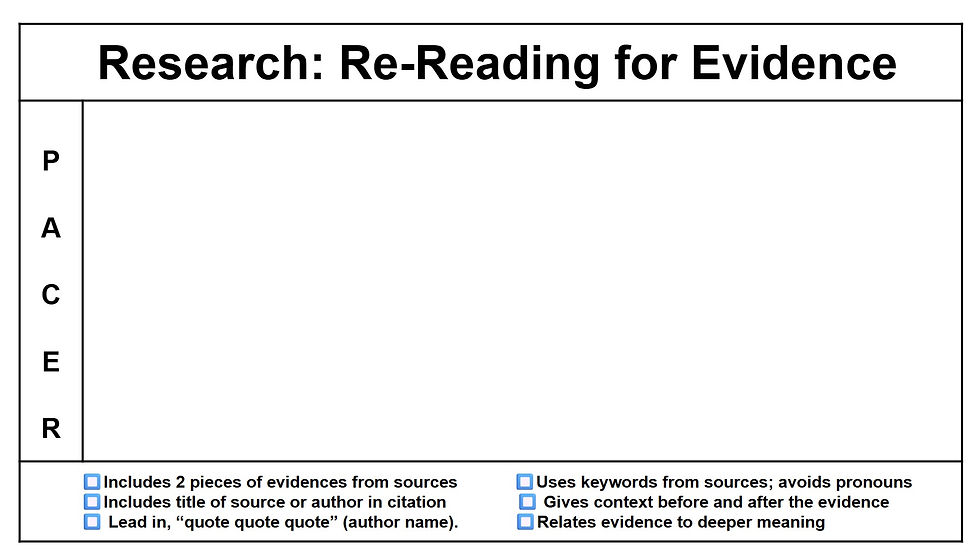
Okay so people have gone all in on RACE as an acronym for a while now. But I'm not convinced that it's getting our students well-written, thoughtful, evidence-based responses. If it were, I wouldn't need to keep hosting sessions on this type of writing!
So instead I like PACER--which stands for:
Paraphrase
Answer
Connect to evidence
Explain your thinking
Repeat
We tell our kids, "Don't just plop the evidence in out of nowhere!" Instead, let's teach them, "Connect context and details of what happened in the text before this quote appears."
Also: AVOID pronouns in the sentences after the evidence. Get rid of "This shows" and instead paraphrase key words from the evidence in the next sentence. Repeating key words creates fluency, focus, and keeps a writer on track.

The Research: 2+ Sources resource is something to use routinely with students. I wanted to include a simple visual cue for students to self-assess (based on what the rubric requires) and also for them to self-monitor if they think their writing is Almost, On Grade Level, or Above and Beyond. We've been talking and teaching a lot about how to build resources that allow the students to do the thinking--so they need resources that allow them (or peers) to do the evaluating with them.

Join me in upcoming, 1 hour sessions where I model each of these resources, show you where to find the links from Indiana, and answer your questions about these 2 types of writing. I'll also share some other mini-lesson ideas on how to help students pick stronger (relevant) evidence (always a need).
Let me know what you think about these resources and what else might be helpful with these skills!


Comments